
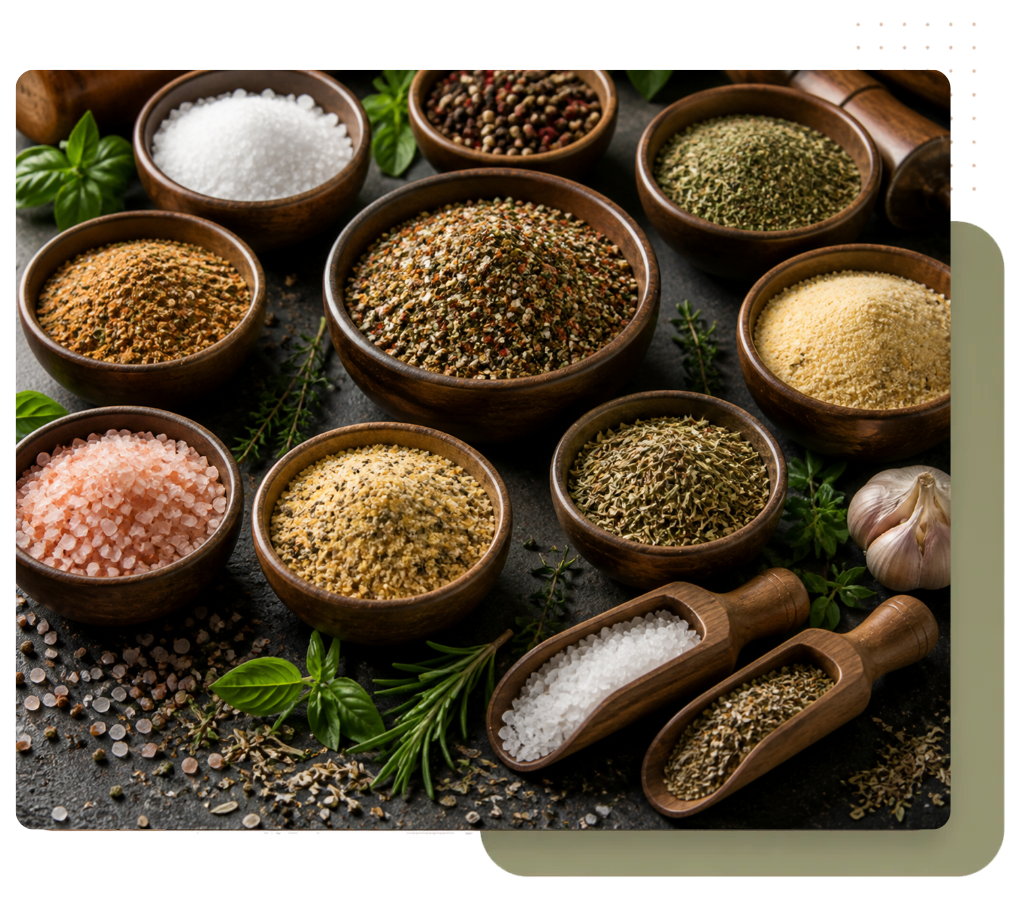
A private label seasoning manufacturer develops, produces and packs seasonings that you sell under your own brand. The process runs in eight stages: writing the brief, formulating or matching the recipe, sampling, signing off the specification, sourcing and testing raw materials, blending and milling, packing and labelling, and shipping with full documentation. Knowing each stage helps you brief the manufacturer well and avoid delays.
This guide is for snack makers, meat processors, foodservice companies, retailers and food brands who want their own seasonings without building a blending plant.
Key takeaways
- A detailed brief covering application, claims and cost target saves weeks of back-and-forth.
- Always trial samples in your own production line before approving them.
- Agree who owns the recipe, in writing, before development starts.
- Spices carry most of the risk in a seasoning, so check where every one is sourced.
In this guide
The private label seasoning process at a glance
| Stage | What happens | What you provide |
|---|---|---|
| 1. Brief | You define the product and its use | Application, flavour target, claims, cost target, market |
| 2. Formulation | The manufacturer creates or matches a recipe | Benchmark sample or existing recipe |
| 3. Sampling | Lab samples are tested in your product | Feedback from trials in your application |
| 4. Specification | Recipe and quality limits fixed in writing | Sign-off on the spec sheet |
| 5. Raw materials | Spices are sourced and tested | Destination market rules |
| 6. Production | Blending, milling, sieving, metal detection | Purchase order |
| 7. Packing | Bulk or retail packs labelled for your market | Artwork and label approval |
| 8. Shipping | Goods ship with batch documents | Incoterm and delivery details |
Stage 1: Write a clear brief
Manufacturers formulate differently for a seasoning dusted onto crisps than for one mixed into a sausage, so tell them exactly how the product will be used. A strong brief includes:
- Application: topical snack seasoning, meat rub, marinade base, ready meal, soup or sauce.
- Flavour target: a description, a competitor product to benchmark, or your own recipe.
- Nutrition limits: maximum salt, sugar or fat content.
- Claims: vegan, gluten-free, no added MSG, organic, Halal or clean label.
- Allergen rules: allergens to exclude as ingredients and as cross-contact.
- Commercials: target cost per kg, annual volume and pack format.
- Market: the countries where the finished product will be sold.
Stage 2: Formulation or recipe matching
Custom formulation
The manufacturer’s team builds a new recipe from your brief. Best for new product launches.
Recipe matching
They reproduce a seasoning you already use, from your formula or by analysing a benchmark sample. Common when switching suppliers.
Agree on recipe ownership before work starts. If you supply the formula, it should stay yours. If the manufacturer develops it, clarify whether you can take it to another producer later, and ask for a non-disclosure agreement covering both cases.
Stage 3: Sampling and approval
Always trial lab samples in your real product and process. A seasoning that tastes right from the bag can behave very differently on a production line, where particle size affects how well it sticks to a snack, and oil or moisture levels change how flavour comes through.
Give specific feedback, such as “reduce heat by about a quarter” or “more garlic on the finish”, and expect two or three rounds before approval. Keep the approved sample sealed as your reference standard.
Stage 4: Sign off the specification
Once you approve a sample, the recipe is fixed in a written specification. Every future batch is checked against this document, so read it carefully.
| Parameter | Why it matters |
|---|---|
| Particle size (mesh) | Controls adhesion on snacks and how evenly the seasoning disperses |
| Moisture | Affects flow, caking and shelf life |
| Salt content | Drives taste and nutrition labelling |
| Colour | Keeps the finished product looking the same batch to batch |
| Microbiological limits | Protects food safety, especially for seasonings applied after cooking |
| Flow agents | Prevent caking in humid conditions; must be declared |
| Shelf life and storage | Sets best-before dates and warehouse conditions |
Stage 5: Raw material sourcing and testing
Spices are the highest-risk components in a seasoning because they can carry pesticide residues, mycotoxins and microbial contamination from the field. If you sell in the EU or UK, every spice in the blend has to meet local residue limits, and one non-compliant ingredient makes the whole blend non-compliant.
Ask where each spice comes from and how it is tested. Seasonings applied after cooking, such as snack dustings, also need spices treated to reduce microbial load, usually with steam. Our guide to EU pesticide residue limits for spices explains what to check.
Stage 6: Blending, milling and quality control
Ingredients are weighed against the approved recipe, milled to the specified particle size where needed, and mixed until the seasoning is uniform. The blend is then sieved to remove oversized particles and passed through a metal detector before packing.
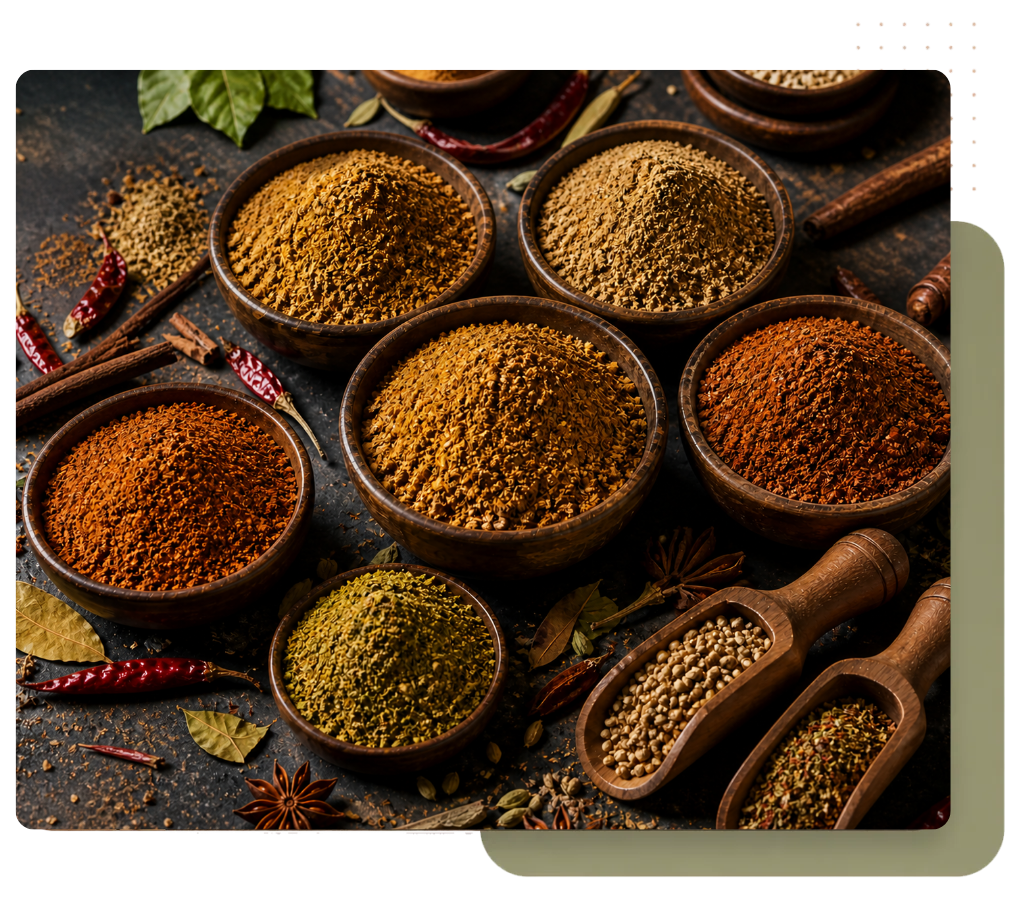
Each batch should be compared with the approved reference sample before release. Ask the manufacturer to keep a retained sample from every batch so any later query can be investigated.
Stage 7: Packing and labelling
Bulk packs, such as lined 25 kg bags or 10 kg cartons, suit manufacturers who use the seasoning as an ingredient or pack it themselves. Retail-ready packs carry your brand and go straight to the shelf.
For the EU, labels must follow Regulation (EU) No 1169/2011: ingredients in descending order of weight, allergens emphasised, net quantity, best-before date and lot number. Mustard, celery and sesame are among the 14 EU-listed allergens and are common in seasonings, so check every blend carefully. The UK has its own, closely related rules.
Stage 8: Shipping and documentation
Each shipment should travel with a certificate of analysis for the batch, the product specification, residue and microbiology results, and the export documents your country requires. Agree the Incoterm in advance. Buyers in the UK can shorten lead times by drawing stock from AQF’s UK warehouse.
What affects MOQs and lead times?
MOQs depend on blender batch size, the number of unique ingredients, and whether you need custom retail packaging. Bulk packs usually allow lower minimums than printed retail packs, because films and pouches have their own print minimums. Lead times depend on ingredient availability, testing turnaround and how quickly samples and artwork are approved. Get both figures in writing at the quote stage.
Common mistakes to avoid
- Approving a sample by taste alone without trialling it on your own line.
- Leaving recipe ownership undefined until you want to switch suppliers.
- Choosing a manufacturer on price without checking where its spices come from.
- Forgetting allergen cross-contact when a “free-from” claim is on the pack.
- Finalising artwork before the recipe and ingredient list are locked.
Private label seasonings from AQF Ingredients
AQF Ingredients manufactures bulk and private label seasonings and custom blends for food manufacturers, foodservice and retail brands. Because we produce our own spices, we control the ingredients that carry most of the risk.
EU standards from harvest
Every spice is grown, dried, milled and packed to EU food-safety and residue standards, with batch documentation.
Match or create
We match your existing recipe or build a new one to your brief.
Milled to your spec
Mesh size, moisture and blend ratios set to your formulation.
Still comparing suppliers? Our checklist on how to choose a bulk spice supplier will help.
Frequently asked questions
What is a private label seasoning?
A private label seasoning is a blend produced by a manufacturer and sold under another company’s brand. The brand owner sets the flavour, specification and packaging, while the manufacturer handles sourcing, blending, quality control and packing.
Can a manufacturer copy a seasoning I already use?
Yes. Recipe matching is a standard service. If you have the formula, the manufacturer reproduces it directly. If you only have the product, they analyse a benchmark sample and refine a match through sampling rounds until you approve it.
Who owns the recipe in a private label agreement?
It depends on your agreement. A formula you supply normally stays yours. A recipe the manufacturer develops may belong to them unless the contract transfers it to you. Settle ownership in writing, with a non-disclosure agreement, before development begins.
Can private label seasonings be made for the EU and UK markets?
Yes, provided every ingredient meets EU or UK residue and contaminant limits and the label follows local food information rules. Choose a manufacturer that sources spices grown to those standards and supplies batch test results with each shipment.
Start Your Private Label Seasoning Project
Send us your brief, benchmark product or existing recipe. We will come back with a formulation plan, sample timeline and indicative pricing.
Send Your BriefSee Custom Blends
Leave a comment