When you buy bulk dehydrated vegetables for food processing, the specification comes down to five things: the cut (flakes, chopped, minced, granules or powder), moisture, colour grade, microbiology and packing. Getting these right decides how the ingredient behaves in your line, how long it keeps, and whether it passes food-safety checks in your market. This guide explains each one, using dehydrated onion and garlic, the two most traded dehydrated vegetables, as the main examples.
Key takeaways
- Choose the cut by application: powder blends in, minced and chopped stay visible, flakes are for rehydrating or further grinding.
- Moisture is the single most important spec for shelf life. Well-made dehydrated onion and garlic are usually supplied below 5 to 6%.
- If the vegetable goes into a product without a further cooking step, specify microbiology limits or treated material.
- Moisture-proof packing matters as much as the product, because dehydrated vegetables absorb moisture from the air.
In this guide
What are bulk dehydrated vegetables?
Dehydrated vegetables are fresh vegetables that have been cleaned, peeled, cut and dried, usually with hot air, until most of their water is removed. Taking the water out stops microbial growth and enzyme activity, so the vegetable keeps for around a year without refrigeration and weighs a fraction of the fresh product.
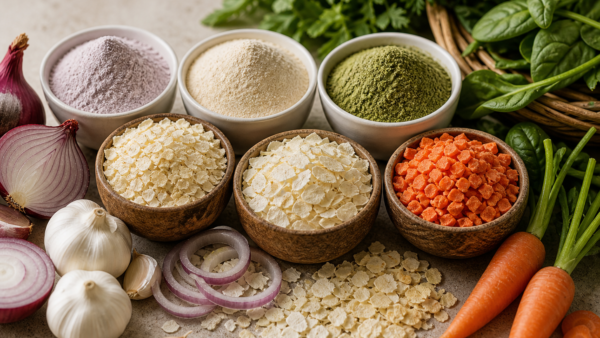
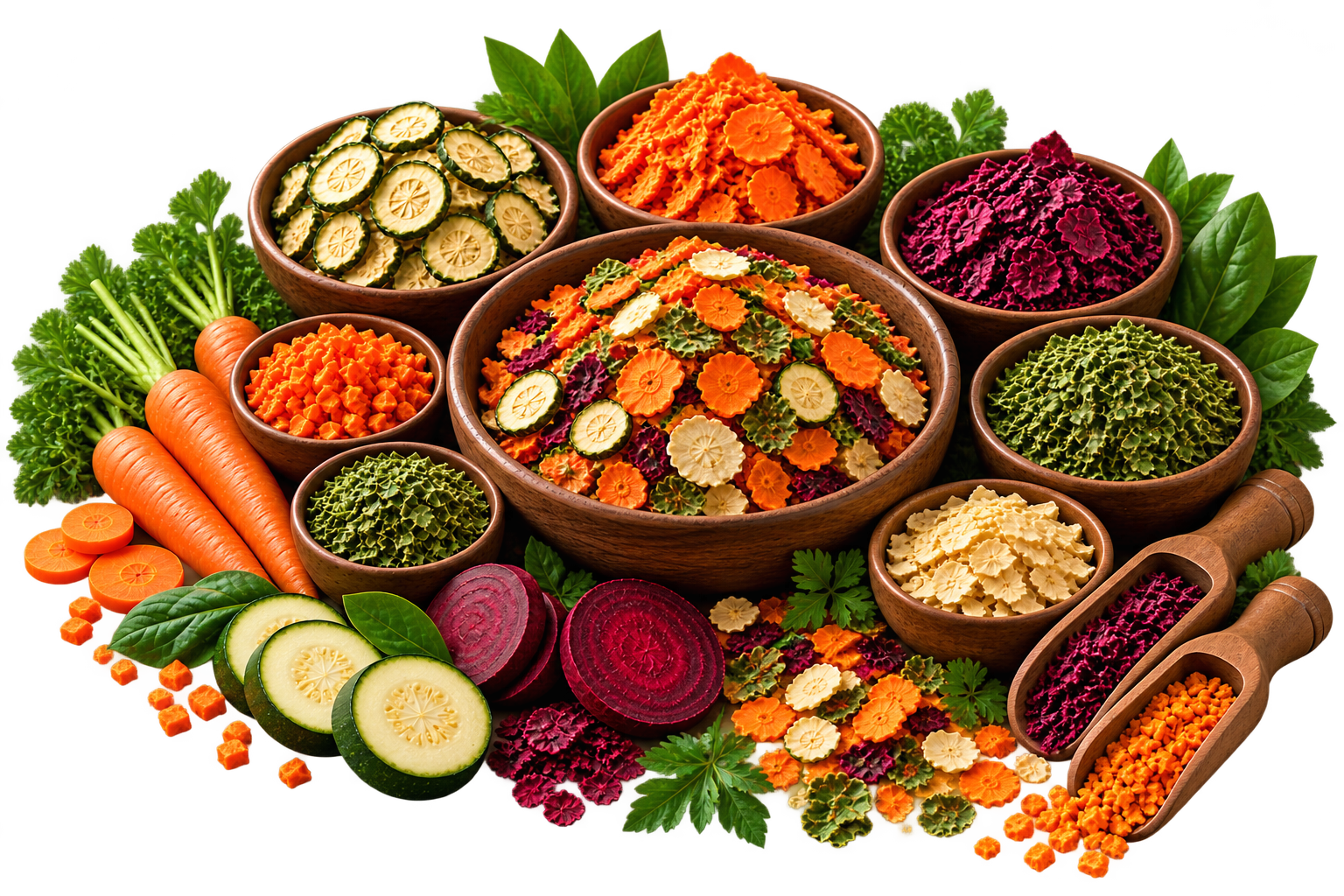
For food manufacturers, that means consistent flavour all year, no peeling or waste on site, lower freight and storage costs, and an ingredient that can be weighed straight into a recipe. Onion and garlic are by far the most widely used, followed by vegetables such as tomato, carrot, cabbage, bell pepper and leafy herbs.
Cuts and particle sizes: which one fits your product?
The same dehydrated onion or garlic is sold in several cuts. The sizes below are typical trade ranges; every supplier works to their own exact limits, so confirm them on the spec sheet.
| Cut | Typical size | Best for |
|---|---|---|
| Flakes (kibbled) | Large natural slices, roughly 8 to 20 mm | Soups, curries and stews that rehydrate during cooking; processors who grind their own powder |
| Chopped | Around 3 to 8 mm | Ready meals, sauces and toppings where visible pieces are wanted |
| Minced | 1 to 3 mm and 3 to 5 mm | Seasonings, marinades, dressings, meat products, pizza toppings |
| Granules | Around 0.2 to 1 mm (roughly 20 to 80 mesh) | Free-flowing rubs, spice blends and dry mixes |
| Powder | Typically 80 to 100 mesh | Snack seasonings, masalas, soups, sauces and instant noodle tastemakers |
A simple rule: the finer the cut, the faster it rehydrates and the more evenly it disperses, but the more it absorbs moisture and the more prone it is to caking. If you need visible pieces, choose minced or chopped. If you need the flavour to disappear into a blend, choose powder.
Moisture: the spec that decides shelf life
Moisture is the most important number on a dehydrated vegetable spec. Too high and the product can cake, darken, lose flavour or support mould growth during storage and sea freight. Well-dried onion and garlic products are usually supplied with moisture below 5 to 6%. Our dehydrated minced garlic, for example, is dried to below 5%.
Ask for moisture to be tested on every batch and shown on the Certificate of Analysis. If you store the product in a humid climate, also ask about water activity, which is a better indicator of microbial stability than moisture alone.
Colour and grades
Dehydrated vegetables are graded mainly on colour and on how much unwanted material, such as skin, root or dark pieces, is present. Better grades have a uniform colour and very few defects. Colour also tells you about processing: dark or brown pieces usually mean the vegetable was over-dried or stored badly.
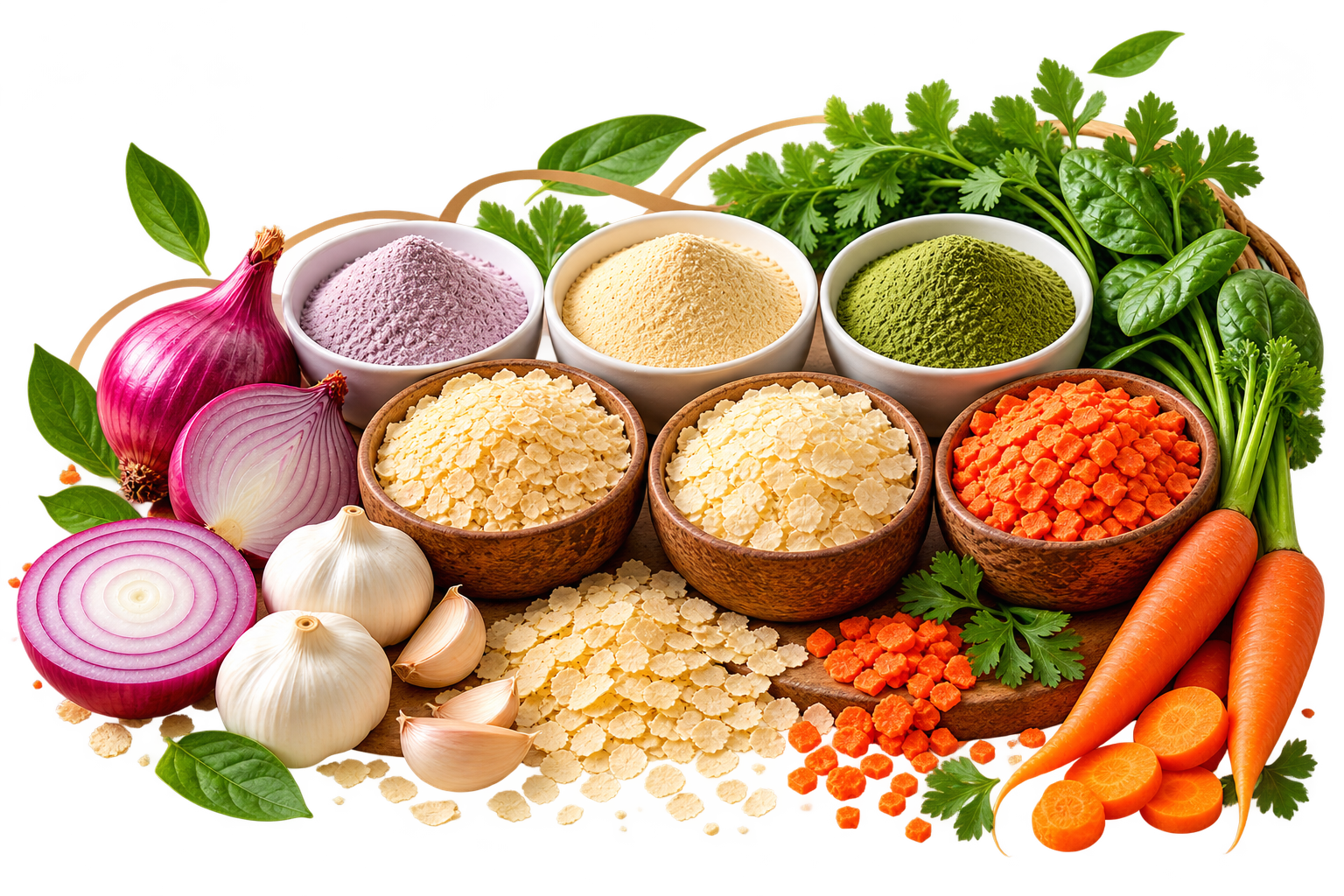
White onion
Creamy white colour and a milder, sweeter taste. Preferred where colour matters, such as cream and onion seasonings, white sauces and dressings.
Red onion
Reddish tint and a stronger, more pungent flavour. Widely used in Indian gravies, masalas and chutneys.
Pink onion
Light pink colour with a flavour between white and red. A balanced choice for gravies and seasonings.
Garlic
Cream to light-yellow colour with a strong, pungent aroma. Graded on colour, size uniformity and the absence of skin.
Microbiology: when it matters most
Air drying removes water but does not sterilise the vegetable, so dehydrated onion and garlic can carry naturally occurring bacteria, yeasts and moulds. That is fine when the ingredient goes into a product that is cooked afterwards, such as a soup or sauce. It matters much more when the ingredient is used without a further kill step, for example in a seasoning dusted onto snacks after frying, a dip or a dressing.
For those uses, agree limits for total plate count, yeast and mould, coliforms and E. coli, with Salmonella absent, and ask whether the supplier offers treated, low-microbial material.
What a dehydrated vegetable spec sheet should include
| Parameter | What to agree |
|---|---|
| Product and cut | Vegetable, variety (white, red or pink onion) and cut |
| Particle size | Size range in mm or mesh, with a tolerance for oversize and fines |
| Moisture | Maximum percentage, tested every batch |
| Colour and appearance | Expected colour, maximum dark or burnt pieces |
| Foreign matter | Limits for skin, root, stones and extraneous material; metal detection |
| Microbiology | Total plate count, yeast and mould, coliforms, E. coli, Salmonella |
| Residues and contaminants | Pesticide residues to your market’s limits, heavy metals |
| Additives | None, or any agreed flow agent declared |
| Packing and shelf life | Pack size and liner, shelf life and storage conditions |
Yield and rehydration: how much fresh vegetable does 1 kg replace?
Because most of the water is removed, a small amount of dehydrated vegetable replaces a lot of fresh produce. As a rough guide, about 8 to 9 kg of fresh onion makes 1 kg of dehydrated onion, while garlic, which has more solids, takes about 3 kg of fresh garlic per kg dehydrated. Exact ratios depend on the crop and the moisture target.
To rehydrate, soak flakes, chopped or minced pieces in water for around 15 to 30 minutes, or add them directly to sauces, soups and curries, where they absorb liquid during cooking. Powders and granules are normally added dry.
Packing, storage and HS codes
Bulk dehydrated vegetables are usually packed in 20 to 25 kg cartons or bags with a food-grade poly liner. Powders are especially sensitive to humidity, so the liner should be sealed and the cartons kept off the floor in a cool, dry store. Stored this way, dehydrated onion and garlic typically keep for 12 months.
For customs, dried onions fall under HS code 0712.20, and dried garlic and most other dried vegetables under 0712.90. Vegetables ground into powder can be classified differently in some countries, so confirm the full tariff line with your customs broker.
Buying mistakes to avoid
- Ordering “onion powder” without specifying the onion type, mesh and moisture.
- Using standard, untreated material in a seasoning applied after cooking.
- Approving a sample without testing it in your own recipe and line.
- Accepting packing without a sealed liner for a long sea voyage.
- Comparing quotes on price per kg without checking that the specs are the same.
Bulk dehydrated onion and garlic from AQF Ingredients
AQF Ingredients manufactures and exports dehydrated vegetables from India for food manufacturers, seasoning companies, importers and distributors. Our range covers white, red and pink onion as flakes, minced and powder, and garlic as flakes, minced and powder. See our dehydrated onion and garlic manufacturing page for details.
Low moisture
Dehydrated minced garlic dried to below 5% moisture for stable storage and shipping.
25 kg bulk packing
Standard 25 kg packing, with custom and private label packs on request.
Frequently asked questions
What is the shelf life of bulk dehydrated vegetables?
Dehydrated onion and garlic typically have a shelf life of 12 months when kept in sealed, lined packing in a cool, dry place. Shelf life shortens quickly if the product absorbs moisture, so reseal opened bags.
What moisture content should dehydrated onion and garlic have?
Well-dried dehydrated onion and garlic are usually supplied below 5 to 6% moisture. Lower moisture means better flow, less caking and a longer shelf life. Confirm the maximum on the specification and check it on every Certificate of Analysis.
What is the difference between dehydrated onion flakes, minced and powder?
They are the same dehydrated onion cut to different sizes. Flakes are the largest pieces and suit cooking and further grinding, minced is a fine cut for visible pieces in seasonings and sauces, and powder is finely ground to blend evenly into dry mixes.
Are dehydrated vegetables safe to use without cooking?
Standard air-dried vegetables can carry natural microbial loads, so they are best used in products that are cooked. For seasonings, dips or dressings with no further cooking step, specify microbiology limits or ask for treated, low-microbial material.
What is the minimum order for bulk dehydrated vegetables?
MOQs vary by supplier and product. AQF’s minimum for dehydrated minced garlic, for example, is 100 kg, which lets buyers run a trial before moving to regular or full-container orders.
Need Bulk Dehydrated Onion or Garlic?
Tell us the product, cut, quantity and destination. We will send pricing, specifications and samples for your R&D team.
Request a QuoteSee Dehydrated Vegetables